
While small and often overlooked, wheel bearings are vital to trailer and caravan mobility. This guide will help you understand their function within your wheel hub assembly, as well as how to correctly identify what bearings you need for your setup.
Outline of Topics:
- What are wheel bearings?
- When do bearings need to be replaced?
- Are there common bearing combinations?
- How to find your bearing information?
- Where to get help with bearings?
This is part of the Couplemate™ Technical Hub introductory unit on mobility.
What are wheel bearings?
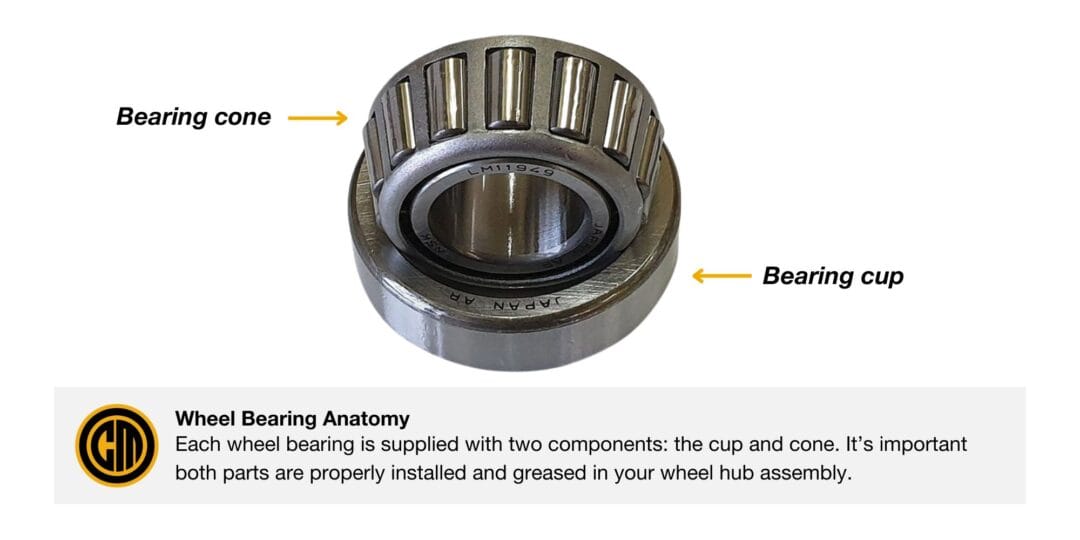
Bearings play a vital role in trailer and caravan mobility. Most Australian setups will use tapered roller bearings, wherein each component consists of two parts:
- a bearing cone
- a bearing cup.
The bearing cone is the main component as it features the cylindrical tapered rollers. The secondary part – the bearing cup – looks like a ring and must be firmly pressed into your hub, disc, or drum. When installed, these parts work together to allow for movement within your caravan or trailer wheel hub assembly.
There are two bearings in each wheel hub:
- 1 x inner bearing (larger, sits closer to the chassis centre)
- 1 x outer bearing (smaller, sits further from the chassis centre).
Once both bearing cups are installed and both cones are greased, the inner and outer bearings can freely rotate on your axle shaft. This is what allows your trailer and caravan wheels to move.
High-quality bearings are typically made from high-carbon chromium steel (commonly called “chrome steel”) or stainless steel. In our experience, lower-quality bearings may incorporate materials (such as ceramics or plastics) that degrade performance, lifespan, and reliability. This is why all genuine Couplemate™ components will use Japanese bearings (mainly NSK).
Additional Information
Bearings have a core role in trailer and caravan weight capacity.
Like most things in the towing industry, weight ratings are primarily determined by the weakest component. For example, trailer/caravan axle ratings are often set based on the bearing configuration rather than the steel grade (we discuss this further in our Guide to Caravan & Trailer Axles).
Moreover, bearings are usually paired with a hub cap and grease seal to prevent lubricant loss. The sizing of both components depends heavily on the bearings you use.
When do bearings need to be replaced?
While regular maintenance and servicing will help maximise the life of your bearings and wheel hub assembly, they’ll eventually need to be replaced.
There’s no set interval for replacing bearings. Instead, ask yourself what you’ve done so far, what you’re doing next, and whether you’ve checked before your last trip. At the very least, given Australian road conditions, it’s essential to have your bearings inspected and re-greased at least once a year. (We would service them more often if you’re a frequent “tower” and/or drive over long distances.)
So, how do you know if you need a new set? If you’re doing any servicing or inspections yourself, look for:
- Discoloured or gritty grease
- Worn rollers or cups
- Surface scratching, and/or
- General roughness.
Any of these signs indicates it’s time to replace it. Additionally, if you experience any odd vibrations or unusual noises, it could signal that there’s a problem with your bearings. (In which case, try to check them as soon as possible!)
Many Australians keep Bearing Kits as spares because they’re convenient and usually more economical than buying individual bearings.
Are there common bearing combinations?
When searching for spares, our team will often ask what combination or configuration you need. Most Australian trailers and caravans we encounter use one of the following combinations of inner and outer.
| Combination / Configuration | Inner Bearing Number (#) | Outer Bearing Number (#) |
| LM 0.75t – Holden | 67048/10 | 11949/10 |
| SL 1.45t – Ford / Slimline | 68149/10 | 12749/10 |
| PLL 1.6t – Parallel / Landcruiser **See Notes** | 68149/10 | 68149/10 |
| AU 2.25t – ALKO 2T | 30210J | 15123/245 |
| AU 3.0t – ALKO 3T | 30210J | 29749/10 |
| DEX 1.6t – Dexter 1600lbs | 68149/11 | 44649/10 |
| DEX 2.0t – Dexter 2000lbs | 25580/20 | 15123/245 |
| TRJ 2.0t – Trojan 2.0t | 48548/10 | 44649/10 |
| VT 2.0t – Cruisemaster / Vehicle Components | 68149/11 | 44649/10 |
| VC 2.0t – Vehicle Components | 68149/10 | 25580/20 |
| COMP 1.0t – Composite | 67048/10 | 12749/1 |
Note: An alternative bearing configuration is known as a Modern Parallel (MPLL). This features the inner bearing 68149, but the outer is 67048.
Given the increase in imported trailers, caravans, and campers, it’s essential to recognise that there are many more combinations than those we’ve outlined above. Moreover, each combination will have different dimension requirements that determine what parts you can (and can’t) run.
This is why your bearing information is so important.
How to find your bearing information?
We often get asked, “What bearings do I need?” If you’re one of the lucky few, this information can be found:
- In an owner’s manual
- On a label/sticker or recent invoice, or
- From the original manufacturer.
In our experience, however, most Aussies resort to the old-fashioned hands-on approach. This means separating your wheel hub from your axle and pulling out the inner and outer bearings. While it’s undoubtedly annoying, manually inspecting your bearings ensures you get the correct information (and the right spare parts).
Bearing Numbers
This is the most effective way to find the right replacement bearings.
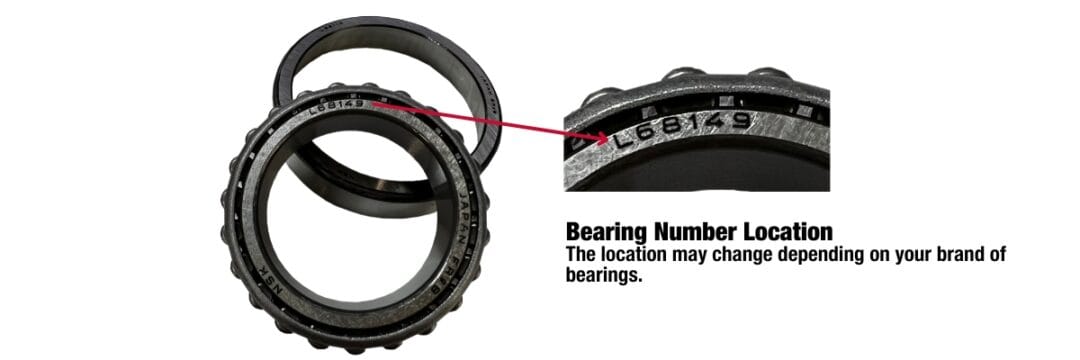
Each bearing will have five numbers on its cup and its cone. It’s essential to record all 5 cone numbers and the last 2 or 3 cup numbers. Moreover, it’s necessary to obtain both the inner and outer bearing numbers.
As a quick example, let’s say you inspected your inner bearing and got the following numbers:
- Bearing cone: L68149
- Bearing cup: L68110
Using the table under “bearing combinations, you know that you have a LM68149/10 as your inner. However, using this same table, you’ll also know that your outer bearing could be a L12749/10 or L68149/10. This is why it’s so important to pull out both bearings.
If you need help with how to read bearing numbers, refer to this image:
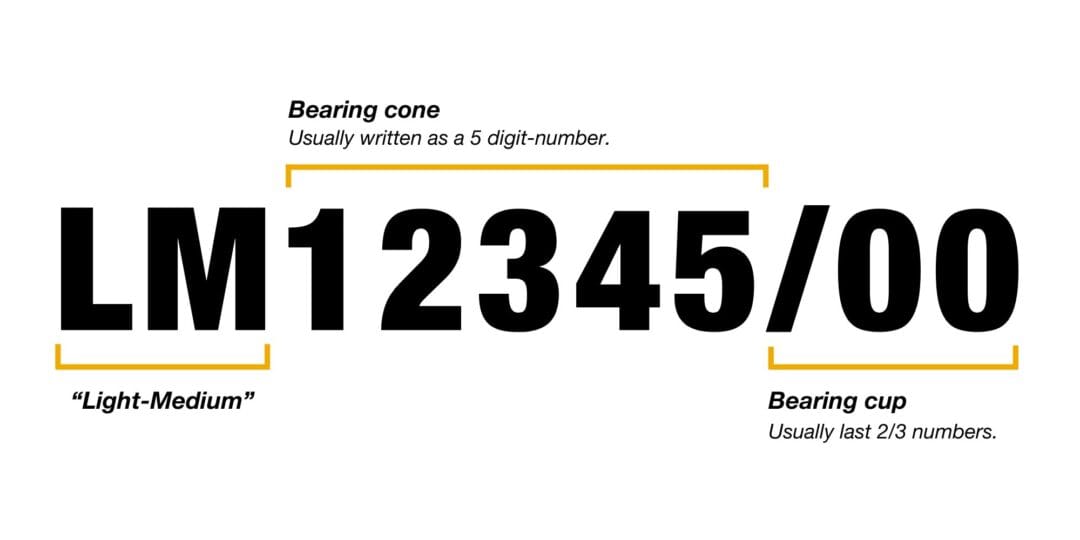
N.B. “HR” is another common prefix in NSK bearing numbers that essentially means heavier duty.
If your bearings are too worn to read, don’t stress! You can also measure your bearings.
Bearing Measurements
Trailer wheel bearing measurements are taken by measuring the outer dimension (“OD”) of the cup and the inner dimension (ID) of the cone. Watch our YouTube short on how to measure bearings here.
You’ll need to benchmark four measurements per hub (or two measurements per bearing). The table below has the ID and OD of common Australian caravan or trailer wheel bearings.
| Bearing Number (#) | ID | OD |
| 67048/10 | 31.7mm | 59.1mm |
| 11949/10 | 19.0mm | 45.2mm |
| 68149/10 | 35.0mm | 59.1mm |
| 12749/10 | 22.0mm | 45.2mm |
| 30210J | 50.0mm | 89.9mm |
| 15123/245 | 31.7mm | 61.9mm |
| 29749/10 | 38.1mm | 89.9mm |
N.B. We always recommend using a digital vernier to measure tricky parts like wheel bearings.
Where to get help with bearings?
If you have trailer bearing numbers, measurements, or combinations that don’t align, Couplemate™ can help.
Feel free to leave a comment, send a message to our Technical Team, or give us a call on 07 3348 3822.
Finally, overview of Industry ADRs & Regulation Material
0 Comments