
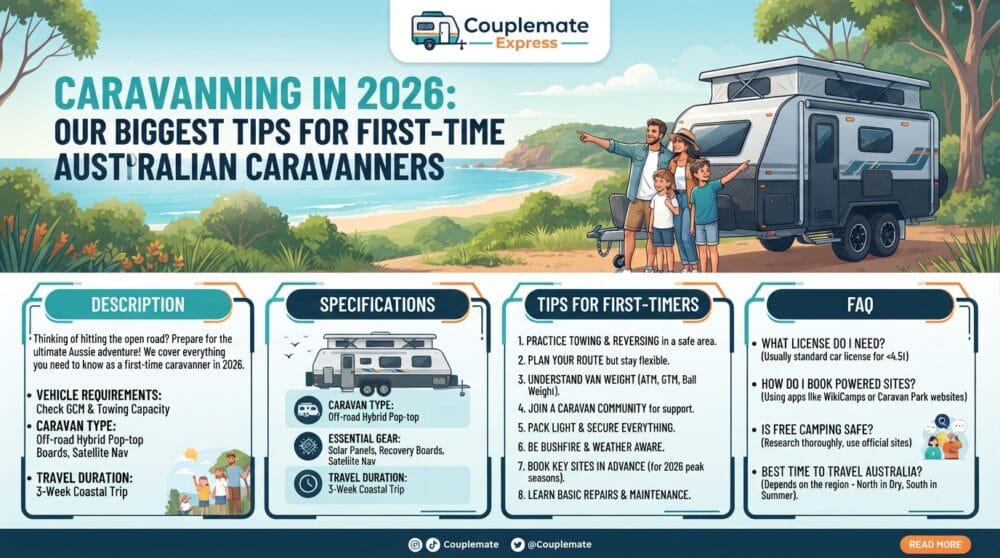
So you’ve bought a caravan…
Or you’re thinking of buying one.
Today, it’s easy to turn to social media for advice. Some advice can help, while other advice can be incorrect, outdated, and dangerous. On top of that, no matter how long someone’s been caravanning, the most basic safety advice can still be new to them.
As a towing parts supplier and manufacturer, we’ve worked with all sorts of caravans: from first-timers to long-time caravanners, we’ve diagnosed countless towing problems and gotten people back on the road.
In this blog post, we’ll share our top caravanning tips for first-time Australian caravanners, based on decades of towing experience.
What do first-time caravanners need to know?
What can your vehicle tow?
If you haven’t bought your caravan yet, you might be thinking: can my car actually tow a caravan?
It’s good you’re asking: not every car can tow a full-size caravan.
“If you’re buying a new caravan and already own a car, choose a van that suits your vehicle’s capabilities. Don’t be tempted to buy a van at the top of your vehicle’s capacity, as you’ll need to factor in the weight of all your gear and passengers.”
How do you pick the right caravan for your car?
There are two types of caravans: pop-tops and full caravans.
Length
On-Road or Off-road?
What’s your car’s towing limit? (Set by manufacturers)
- Maximum braked towing limit
- Tow ball weight
- Gross Vehicle Mass
- Aggregate Trailer Mass
- Gross Combination Mass
Why is weight distribution so crucial? What is weight distribution?
Put simply, weight distribution is how the total mass of your new caravan and gear is shared between your car and caravan. Specifically, weight distribution refers to how that weight is distributed across the contact points with the road (your tyres and axles).
You can either have even weight distribution – which is the goal – or uneven weight distribution – which is not the goal, and can be dangerous.
In regard to uneven weight distribution, too much weight at the rear of your caravan can cause trailer or caravan sway. Too much weight at the front can lift your car’s headlights off the ground, reducing steering control.
Here is a great video on how both even and uneven weight distribution affect the stability of your towing setup.
So how can you ensure you have even weight distribution?
Do you have caravan sway? Is the front of your towing vehicle lifting off the ground? Do your front brakes work?
Before you find this out on a caravanning holiday, go to a weighbridge at your nearest BP: there, you can find out if your weight distribution is even and if you are overloaded.
Why is overloading so dangerous? How do you tell if you are overloaded?
How can you tell if you are overloaded? Check your VIN plate.
Your VIN plate shows some important weights: tare, payload, and ATM.
Your Tare is the total weight of your empty caravan as it leaves the manufacturer: so no gas, water, food, etc. Only the manufacturer or a licensed legal modifier can legally alter it.
Your Payload is the total weight of everything you put into the empty caravan. All of your gear, water, gas, and more.
Your ATM is the maximum legal weight your caravan can be when fully loaded. Basically, it’s your tare weight, plus your payload.
Check your VIN plate to see what your ATM is, and visit a weighbridge at your nearest BP to check if your towing setup’s current weight is over your ATM.
How does towing change when driving on off-road conditions vs on-road?
Driving on a public road is very different to driving off-road, especially in the Australian outback.
Public roads are flatter, with less vibration fatigue and wear.
Off-road conditions provide a different driving experience: If you have on-road towing accessories and you drive your caravan on off-road environments, you may face quicker wear and breaking of your towing parts such as brakes, suspension springs and shock absorbers, inadequate suspension leading to a rougher ride, inadequate ground clearance for terrain that isn’t flat, vibration fatigue, and more.
Can you operate off-road towing setups in on-road conditions safely? Yes.
How does driving change when you are towing?
- More time to stop
- More space to turn, especially when driving with vehicles around you
- Speed limits
- Smooth braking and acceleration
- Reversing is more difficult
- Crosswinds
- Braking
- Caravan sway
- Fuel consumption
- Terrain
How do you maintain my caravan? Why should I?
Do you have some specific questions that you’d like expert advice on?
Don’t stress.
Got questions? We’ve been supplying, manufacturing and providing expert support on towing parts for decades.
Give us a call on 07 3348 3822, email us at sales@couplemate.com.au, or come in to our Wynnum, Queensland shop for in-person support.
0 Comments