

Electric caravan brakes are a commonly-used brake setup.
So below, I will bust some common electric caravan brake myths. Because even auto electricians get it wrong sometimes.
This article is part of the Couplemate™ Frequently Asked Questions Technical Hub unit.
___________________________________________________________________________________________________________________________________
How do electric caravan brakes work?
Firstly, I will explain how electric caravan brakes work so you have a base understanding for the busted myths.
Electric caravan brakes are electro mechanical. When energised, the magnet attaches to the drum’s inner face; the spinning drum face presses against the magnet arm, which in turn expands the brake shoes.
Their brake magnet design is important, as caravan electric brake magnets cannot operate in reverse if wired incorrectly. This is because it doesn’t matter how you wire a magnet; the magnets do not have a set positive or negative wire. It’s the trailer that has a set positive and negative end.
To expand on this, let’s learn more about the design of an electric caravan brake magnet.
Basically, a copper wire is wound around a bobbin several thousand times to generate the EMF (Electromotive force) in a magnet. The two cables you see on an electric caravan brakes magnet are the start of the winding and the finish of the winding.
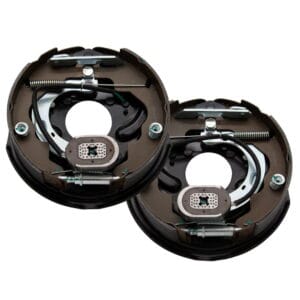
10″ Electric Backing Plate Set
Myth 1: If one wheel is hotter than the other, the issue is located at your hot wheel
It would be reasonable to think the problem is located at this hot wheel, yes?
The answer is actually NO, but let me explain.
The step is essential. With the car running and someone manually operating the electric caravan brake controller (not putting their foot on the brake), engage the brakes.
Measure your voltage on all magnets. Your voltage should all be around 14V at the battery, the trailer plug and magnets. The lowest voltage should be at the last magnet in the wiring system.
Fact
*** The opposite magnet to the hot one on the same axle is LAZY and low-voltage. ***
It is considered lazy because it is not receiving sufficient voltage.
Your Solution
Double the wire size for all undersized voltage readings.
Myth 2: Your trailer cable needs to be the same size as your magnet cable
It is not uncommon for manufacturers to fall into the trap and install cable that’s the same size as the magnet.
Fact
Your actual cable size should be double this size.
The wiring exiting the magnet is the largest cable size the magnet manufacturer can install in the magnet bobbin.
On this point, an auto electrician told me I was wrong and that he had been using his cable methods for 40 years.
I explained to him that I was a Master Craftsman Electrical and that I had held an Electrical Fitter/Mechanic Licence issued in NSW in 1976.
I offered to send him the voltage drop calculation for his trailer build, but he said it was unnecessary.
A cable’s electricity flow is much like a storm water pipe. A narrow pipe with a large force of water flowing through it is bound to take much longer than a wider pipe.
The points above are the primary causes of the electrical braking issues we receive at Couplemate.
Myth 3: Running cable from one magnet to another results in no voltage loss
A bit of background before I tell you why this is a myth: Electric caravan brake magnets are only sold in 10″ and 12″ sizes.
10″ electric magnets draw 3.2 amps, and 12″ electric magnets draw 3.4 amps.
The standard battery voltage for 10″ and 12″ magnets 12 volts at 3.2 amps. This means that there is a total of 38.4 watts per magnet.
With this in mind, the biggest mistake when wiring electric caravan brake’s magnets is to run 3mm cable down one side, then run additional cable across the axle to the other magnet and connect them (see the below diagram for a visual of this).
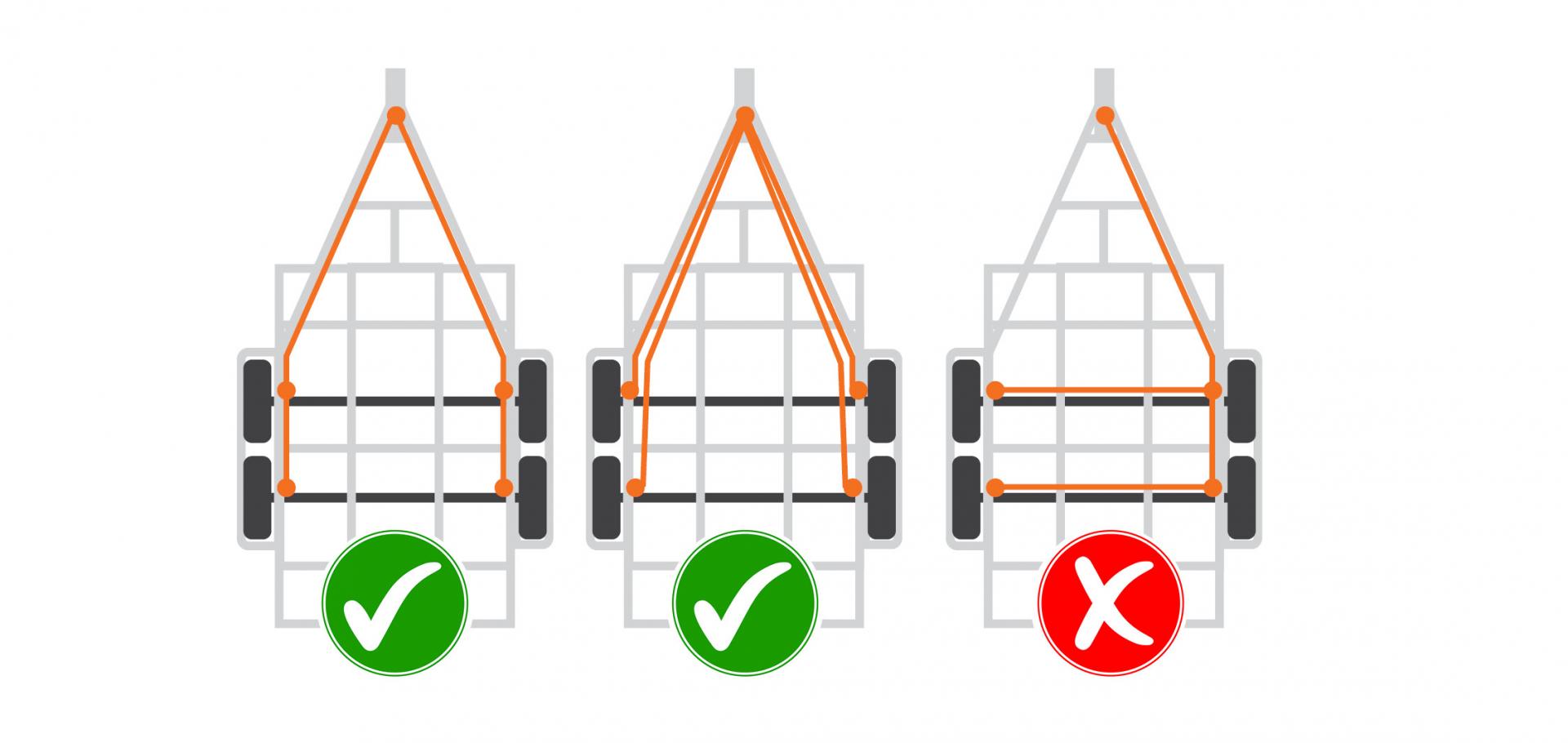
Incorrect electric trailer brake wiring methods. Photo courtesy of TrailParts.
Fact
Why is this? It’s because the longer the cable run, the larger the voltage loss.
Let’s say a cable is drawing 76.8 W at less than 12 V.
The correct method is to run a 3mm or larger cable down EACH chassis rail and connect each magnet independently (the centre example in the above image).
This type of connection reduces copper losses and the resulting voltage loss.
How to correctly wire your electric braking system. Photo courtesy of Alko.
How undersized cable wiring impacts your braking experience
Most electric caravan brake controllers are proportional-controlled. The easiest way to explain proportional control is to think of a pendulum.
When your car is moving forward, the pendulum moves back and forth due to your car’s inertia.
The more braking you apply (the pendulum moves forward), the more current is drawn by your brakes.
It’s normal for your brakes to not work when stationary.
Quite often, I will get a call about uneven braking or one brake being stronger than the other.
This problem is often caused by undersized cable wiring in a series. If you are experiencing brake problems, it is most likely a cable issue.
Wiring the electric brake magnets with a cable of a larger size
When you do wire your electric caravan brake magnets, use 3mm for a single axle setup (2 magnets) and 5mm for tandem axles (4 magnets).
As discussed, voltage drop is caused by an insufficient copper thickness inside the cable, which leads to uneven braking. The more copper thickness the cable has, the less of a voltage drop chance there is.
Side Note: Do not connect your taillight to your electric caravan brakes, as it is wired with a very light cable. Voltage losses occur when taillights are connected directly to your magnets.
More electric caravan brakes wiring tips
- Brake Shoe Bedding: Adjust your brakes so your wheel spins between 1/2 and 1 revolution. Re-adjust after 200 km to allow for the shoes to be properly bedded in.
- Use a good brand of electric backing plate: Not all backing plates are the same.
- Overheated brakes can often be from worn Chinese bearings: If there is not much dust in your drums, the hot brakes are likely faulty bearings.
- Tighten your magnet arm: Loose magnet arms can cause uneven wear on the magnet and a loss of breaking power.
- Ensure your brake shoe notches are aligned properly with the brake adjuster: Shoes aligned incorrectly can cause the drum to heat up. Ensure your shoes are perfectly round and not off centre from the backing plate base.
- Do not connect your taillight to your brakes: It is wired with a very light cable. Voltage losses occur when taillights are connected directly to your magnets.
- If one part of a backing plate is worn, it’s likely that many other parts of the backing plate are worn as well: Make sure you check the quality of the other parts.
-
- It’s also a time-saver to replace the whole backing plate: It can be both a difficult and break-prone installation process to just install new magnets.
0 Comments