

A customer turned up today and asked for a large, extinct Dexter Oval Magnet because he believes it works better than the smaller brake magnets that are plentiful everywhere.
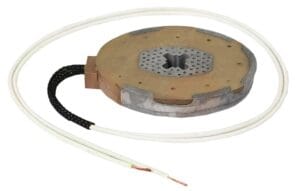
The customer’s magnet.
Penny, our social media guru, served the customer who showed him a magnet from our website.
It was the magnet with a cross in the middle.
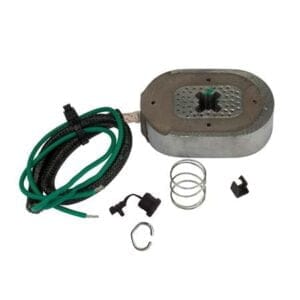
Our magnet.
Is it as powerful as the larger Dexter magnet I am currently using?
This is a really technical question I overheard, and I couldn’t help but assist that customer.
I addressed the customer and advised that most magnets are wound to achieve a specific resistance, and from that resistance, a current is produced at a given voltage.
In short, the larger magnet would have the same resistance as the smaller one because the smaller unit has more turns to produce the same amount of magnetism.
I could see the customer was lost in the explanation, so I asked whether his caravan was wired with the same-sized cable as the electric brake magnet before him.
Yes, was the answer.
And he said he had his brake controller serviced recently to ensure his brakes were working efficiently.
Terrific. Now, when you are installing these new magnets and the car is running, check the voltage at the magnet.
You should get 14.xx volts with the engine running and 12.xx volts without the engine running (at the battery).
So measure the voltage at the magnet, and you will get a surprise.
If you have over 12v, then everything is good; if over 14v, then you cannot get better than that.
However, I suspect you are getting 10v or 11v, and your braking system is suffering voltage loss.
Sadly, I have seen many, many caravans that cannot stop because their braking system is 30% to 40% less efficient than it should be.
The confusion lies in cable sizing.
- Electrical cable sizes are 3mm, not including insulation.
- Automotive cable sizes are 3mm, including insulation.
When using automotive cable, use a 5 or 6mm cable to significantly eliminate voltage losses in the magnet.
Drum Surfaces
The surface of your magnet inside the drum is crucial for effective braking.
Many Chinese manufacturers use poor-quality material to make their drums. Poor material is evident in metal scouring inside the drum, particularly on the magnet surface.
These drums can be machined to produce a smooth surface; however, they do not last long before they return to their scoured state.
AL-KO and Couplemate make the best quality drums on the market. The AL-KO drum is well known and widely used as the preferred brake drum by most caravan dealers nationally.
The Couplemate Drum is made in Australia from quality materials.
0 Comments