
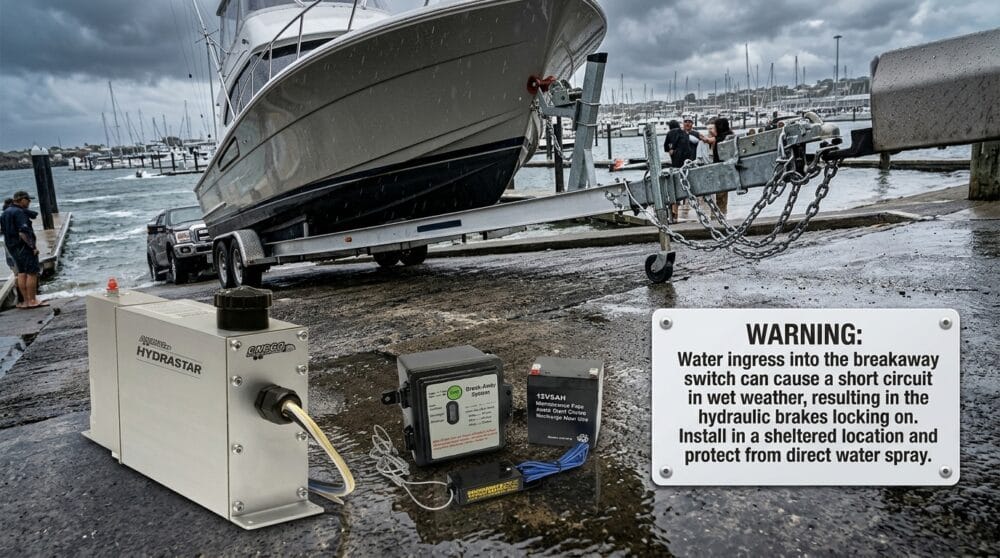
⚠️ WARNING / NOTICE
Water ingress into the breakaway switch can cause a short circuit in wet weather, resulting in the hydraulic brakes locking on or hot brakes in heavy rain.
Description & System Overview
A hydraulic breakaway system is a critical safety fail-safe legally mandated in Australia for all boat trailers and caravans with a **Gross Trailer Mass (GTM) over 2,000 kg **. The system features a dedicated 12V battery sub-circuit mounted on the caravan A-frame or interior. This circuit routes directly to the caravan’s electric brakes through an external breakaway switch.
When launching the boat, do not submerge the breakaway switch in water; otherwise, saltwater will short-circuit the contacts, locking the brakes on.
Under normal towing conditions, a non-conductive nylon pin holds two internal spring-loaded copper contacts apart.
The breakaway switch mechanical lanyard cable must be connected firmly to a **permanent chassis point or dedicated eyelet on the tow vehicle**—never looped loosely to the safety chains or the removable tow ball assembly itself.
If the boat trailer completely detaches from the towbar during transit, the lanyard’s mechanical tension pulls the pin clear of the housing. This closes the electrical circuit and instantly transfers 12V auxiliary battery power directly to the brake magnets, locking the trailer brakes and bringing it to a safe halt.
Wet Weather Troubleshooting Steps
- Isolate the Tow Vehicle Link: Safely pull over to a level surface out of traffic. Disconnect the trailer’s primary 7-pin or 12-pin electrical plug from the vehicle bumper to prevent a reverse-voltage spike from feeding back into your in-dash brake controller.
- Inspect the Breakaway Housing: Examine the small plastic breakaway switch block mounted on the A-frame. Look for moisture beads, water dripping from the pin seam, or noticeable structural splits in the plastic.
- The Rapid Pin Purge Test: Manually pull the nylon pin completely out of the switch body. Let it sit for 5 seconds, then firmly slide it back into the internal tracks until you hear an audible click. This mechanical friction can scrape away built-up road grime or displace pooled water that shorts the internal contacts.
- Dry the Electronics Externally: If available, spray a liberal amount of moisture-displacing electrical contact cleaner or WD-40 directly into the pin entry slot to break down the internal water bridge.
- Perform a Functional Pull-Pin Verification: With the primary vehicle plug still disconnected, pull the breakaway pin out purposefully. Listen closely near the caravan tyres for an audible hum or click as the brake magnets engage. Reinsert the pin immediately after testing to protect your auxiliary battery from rapid, complete discharge.
System Technical Specifications
| Specification Metric | Standard Operational Requirement |
|---|---|
| Legal Mandate Boundary | Required for all trailers/caravans with GTM exceeding 2,000 kg |
| Minimum Emergency Engagement | Must sustain continuous brake lock for a minimum of 15 minutes |
| Auxiliary Battery Voltage (Healthy) | ≥ 12.6V resting; values dropping below 12.0V under load imply failing cells |
| Average Lifespan of Switch Block | 2 to 4 years (highly dependent on UV and road moisture exposure) |
| Est. Replacement Cost | Approximately $30 AUD (Unit is non-repairable; replace if failed) |
Frequently Asked Questions (FAQ)
Q: Can I loop the breakaway lanyard wire securely over my safety chains on the tow bar?
A: No. Never attach the lanyard to the safety chain loops, the receiver shank, or the hitch ball. If the entire towbar or hitch assembly cleanly shears or detaches from your vehicle chassis, the safety chains go with it. In that scenario, the pin will never pull out, rendering the backup safety brake useless. Clip it directly to a permanent, structural eyelet welded directly to the vehicle chassis frame.
Q: My Breakaway battery monitor test button shows a green light. Does that mean the switch works?
A: No. Pressing the internal test box button only confirms the backup 12V battery’s charge condition. It cannot see the physical state of the external switch block. The only way to verify true mechanical and electrical switch integrity is to perform a stationary physical pull-pin test.
Q: Can I leave the pin pulled out while parked at the boat ramp to act as a convenient handbrake?
A: Absolutely not. Pulling the pin sends constant, maximum current directly into your hydraulic actuator brakes. Leaving it out will drain your breakaway battery within hours and melt or structurally deform your brake calipers from extreme heat. Always use dedicated physical wheel chocks and the manual mechanical handbrake lever instead.
Finally, suggestions? Buy a breakaway switch with a rubber boot cover.
0 Comments